Opcije pristupačnosti Pristupačnost

News

Orientation Day for first-year undergraduate students of the Faculty of Engineering in Pula will begin with an introductory lecture on Monday, 5 October 2026 at 10:00, in room 323. To find room 323, enter the building through the main entrance and take the corridor to the left until you reach the stairs. Go up to the second floor; room 323 is in the corridor on the left-hand side. Signs for the Faculty of Engineering (TFPU) rooms have also been put up in the building's corridors, so you can follow them when you arrive.

Winter semester classes for the 2026/2027 academic year begin on Tuesday, 6 October 2026 for undergraduate programmes. First-year undergraduate students will have an introductory lecture on Monday, 5 October 2026. Classes for graduate programmes begin on Monday, 12 October 2026. Timetables for all study programmes for the 2026/2027 winter semester are available at the link.

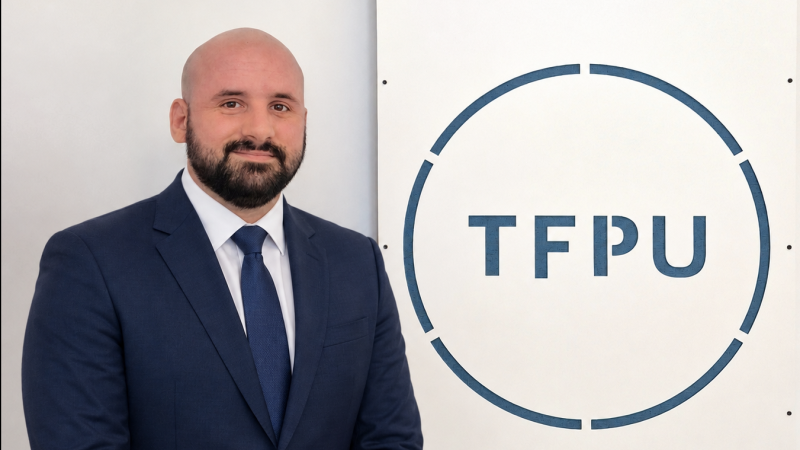
Assoc. Prof. Diego Sušanj, PhD, Is...
Diego Sušanj is an Associate Professor at the Faculty of Engineering, Juraj Dobrila University of Pula, where he has worked since 2024. He received his PhD in computing in 2021 from the Faculty of Engineering, University of Rijeka, where he had also earned his earlier degrees in computer engineering. He built his career at the Faculty of Engineering in Rijeka, working first as a teaching assistant (2015–2021) and then as a senior teaching assistant (2021–2024), before taking up his current position in Pula. Key points of his programme: Developing and restructuring study programmes: moving the mechanical engineering programme from a professional to a university undergraduate programme, with possible specialisations in interdisciplinary engineering systems, automation and robotics. This also covers preparing a new electrical engineering programme and keeping the curriculum in line with labour-market needs. Strengthening cooperation with industry and the public sector: building systematic links with industry through joint projects, student internships and applied research. Engaging with secondary schools and the local community: promoting the Faculty among secondary-school students through school visits and open days. Strengthening research and project activity: raising research output and success in applying for national and European projects, strengthening research groups, and encouraging interdisciplinary collaboration. Improving student standards: a better class timetable, a coordinated schedule of midterm exams, and teaching staff who are easier to reach.

Participation in the International...
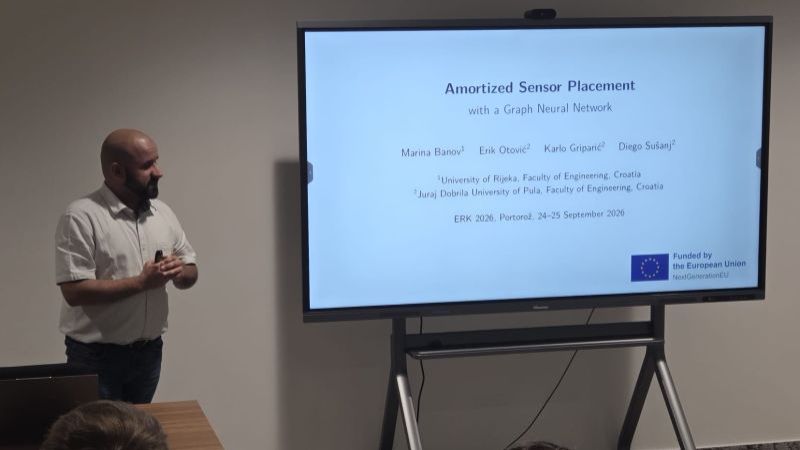
Diego Sušanj, a member of the BioPatchNet project team, took part in the 35th International Electrotechnical and Computer Science Conference (ERK 2026), held on 24–25 September 2026 at the Bernardin Congress Centre in Portorož, Slovenia. The conference is organised by the IEEE Slovenia Section together with the Faculty of Electrical Engineering, University of Ljubljana, and other Slovenian professional societies. It brings together researchers in electronics, telecommunications, computer science, pattern recognition, biomedical engineering and related fields. At the conference, Diego Sušanj presented the paper Amortized Sensor Placement with a Graph Neural Network , by Marina Banov, Erik Otović, Karlo Griparić and Diego Sušanj. It was given as an oral presentation in the Spatial & Environmental Vision session. Taking part in ERK 2026 made the project's research more visible and opened up chances for further collaboration with researchers from the region in machine learning and pattern recognition. Participation was funded by the European Union – NextGenerationEU through projects IIP_UNIPU_010153 and IIP_UNIPU_010148.

Author: Diego Sušanj
Participation in the International...
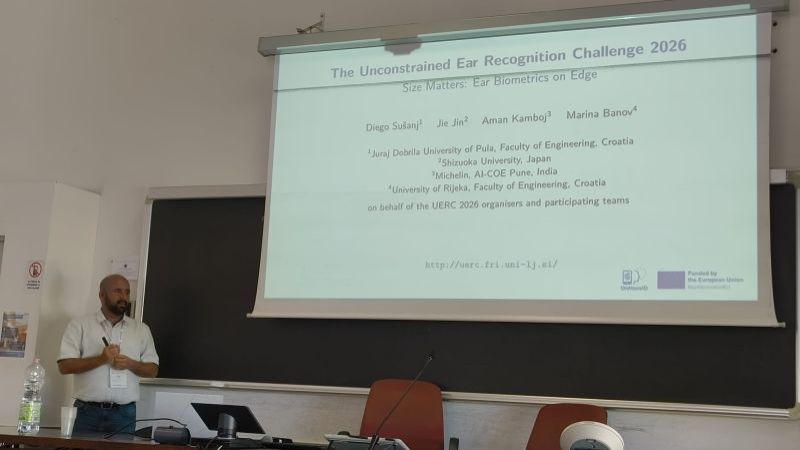
BioPatchNet project team members Diego Sušanj and Marina Banov took part in the International Joint Conference on Biometrics (IJCB 2026), held in Rome from 1 to 4 September 2026. IJCB is the world's leading biometrics conference. It brings together IEEE and IAPR researchers and is a central venue for sharing the latest scientific advances in the field. Earlier, the project had organised and run an international competition, The Unconstrained Ear Recognition Challenge 2026. Team members prepared the challenge: they defined the evaluation protocol, prepared the data, and collected and evaluated solutions from participants around the world. The competition and the analysis of its results led to the paper presented at the conference. At the conference, Diego Sušanj presented the paper The Unconstrained Ear Recognition Challenge 2026 – Size Matters: Ear Biometrics on Edge . It was given as an oral presentation in the competition session and also shown at the poster session, which allowed more detailed discussion with other participants and biometrics experts. Taking part in IJCB 2026 made the project's research more visible and opened up chances for future international collaboration in biometric recognition. Participation was funded by the European Union – NextGenerationEU through project IIP_UNIPU_010148.

Participation in the DeepLearn 2026...
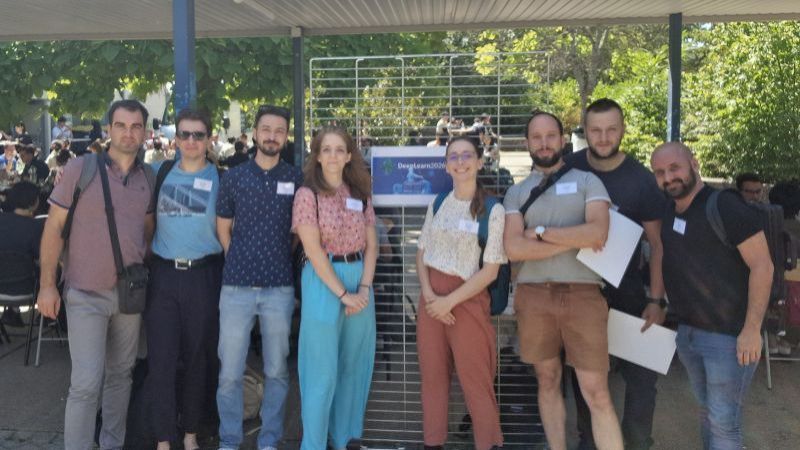
Karlo Griparić, Erik Otović and Diego Sušanj took part in the 13th International Summer School on Deep Learning (DeepLearn 2026), held from 20 to 24 July 2026 in Orléans, France. The summer school was organised by the University of Orléans and the IRDTA institute. It brought together deep learning researchers and students through lectures and workshops. Our researchers' participation helps them share knowledge and build skills in machine learning, in line with the project's research activities. Participation was funded by the European Union – NextGenerationEU through projects IIP_UNIPU_010153 and IIP_UNIPU_010148.

Call for Papers: Special Issue on...
We are pleased to announce the Special Issue  “Processing–Microstructure–Property Relationships in Non-Ferrous and Functional Alloys”  in the international peer-reviewed journal  Materials  (MDPI). The Special Issue belongs to the section  “Metals and Alloys”  and is open for manuscript submissions until  20 March 2027 .

Call for Papers: Special Issue on...
We are pleased to announce the launch of the Special Issue "Additive Manufacturing, Metal Forming, and Structural Integrity of Metallic Components" in the international peer-reviewed journal Materials (MDPI). The Special Issue is now open for manuscript submissions, with a submission deadline of 20 March 2027 . [mdpi.com]

International Mobility of Students...
The Faculty is pleased to highlight the participation of our students, Mihael Holi and Tin Nanndo Jovanović, in a semester exchange within the CEEPUS network International Cooperation in Computer Science , coordinated by Prof. Tihana Galinac Grbac. Within the same framework, a teaching and research mobility of Prof. Tihana Galinac Grbac was also carried out. During their stay at Johannes Kepler University (JKU) in Linz, at the Institute for Network and Security , the students and the professor were hosted by Prof. Michael Sonntag, the JKU coordinator of the CEEPUS network International Cooperation in Computer Science . Both the students and the professor actively participated in teaching and research activities, further strengthening academic and scientific collaboration between the institutions. As part of their activities, the students are involved in the research project Study on Network Conditions Impact on Immersive User Experience in Educational VR Scenarios . Prof. Tihana Galinac Grbac delivered an invited three-day mini-course entitled Functional Programming for Management and Orchestration of Virtualised Network Resources , intended for senior-level students. In addition to teaching activities, the professor engaged in discussions on establishing new scientific collaborations, including agreements on future joint research projects and activities within the institutional project EQUYSIS. This visit included a range of teaching and research activities and represents an important step in further developing and strengthening international cooperation between the Faculty and the University. CEEPUS mobility programmes play a key role as an instrument of internationalisation, providing students and academic staff with opportunities to gain international experience and enhance their visibility within the European academic area.